
Where mice find a foothold around Kuna
New homes on old ground. Many of Kuna’s newer neighborhoods were built on former farm and sage land. Mice that lived in those fields don’t disappear when the houses go up. Fresh construction can leave small openings around garage doors, utility lines and foundation vents, and mice find them quickly.
Water and cover. Indian Creek, the greenbelt, canal laterals and irrigated lawns hold moisture, seeds and tall growth through the dry summer. Those strips give mice food and hiding places right next to backyards.
Downtown’s older buildings. Near Main Street and the railroad, older brick buildings and long-standing homes have more years of settling, more wall voids and more stored items. That gives mice room to nest out of sight.
Acreage and the sage edge. Shops, barns, sheds and stored feed on farm and acreage lots draw mice all year. On the dry sage ground south of town, deer mice are part of the native landscape, and they often move into outbuildings and cabins first.
The fall push. Harvest, cooling nights and the end of irrigation season remove food and cover in the fields. Garages, crawl spaces and sheds start to look like good winter quarters.
Telling the two species apart, and what they leave behind
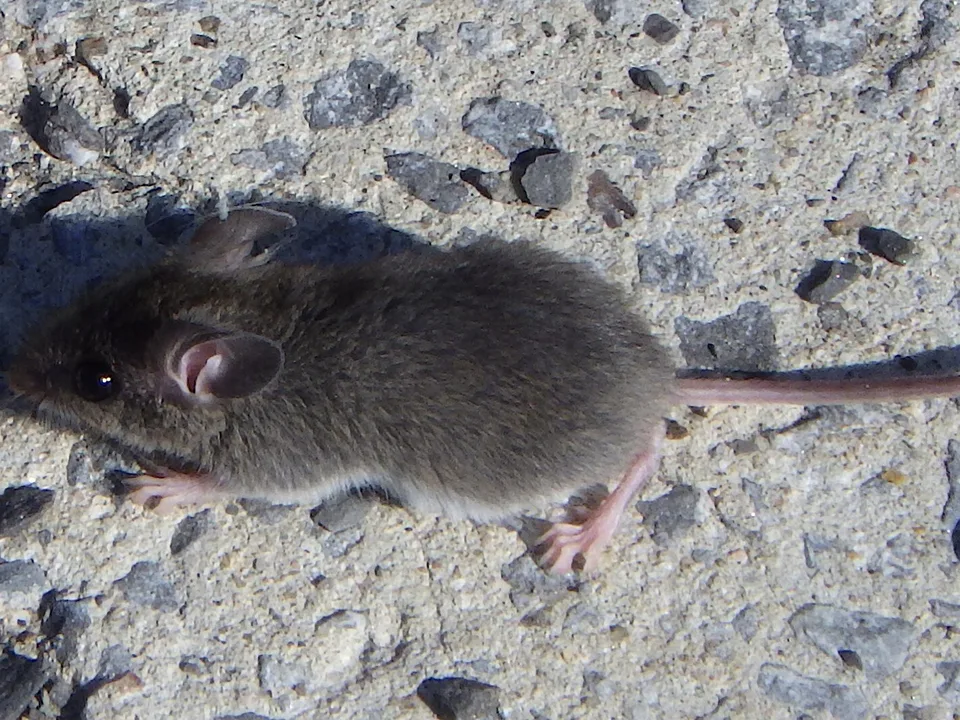
- Deer mouse. This one has a sharp two-tone look: brown or tan on top, with a clean white belly, white feet and a tail that is dark above and pale below. It eats seeds, insects and fruit, and it nests in burrows, woodpiles and buildings that sit empty. Deer mice carry Sin Nombre hantavirus in Idaho (Central District Health).
- House mouse. This mouse is a fairly even gray-brown with a lighter, not bright white, underside and a nearly hairless tail. It nibbles at many foods without finishing them, so it ruins far more than it eats. It also builds nests from shredded paper, fabric and insulation (WSU Pestsense).
- Droppings. Pellets are small and dark, about the size of a rice grain, and noticeably smaller than rat droppings. Look for them along walls, in drawers and near stored food (Central District Health).
- Other clues. Watch for gnawed corners on boxes and bags, a musky smell in closed spaces, and dark smudges where fur rubs along a regular path. Urine stains can also show up along the routes mice travel (WSU Pestsense).
Health concerns: hantavirus and contaminated surfaces
- Hantavirus is rare but serious. Central District Health reports that Idaho sees very few cases. The illness comes from deer mice, and it does not spread from one person to another (CDH). People are usually exposed by breathing in particles from mouse urine, droppings or nesting material, often in closed-up sheds, cabins and garages.
- Clean-up method matters. The CDC warns that sweeping or vacuuming dry droppings can put particles into the air. It describes a wet method instead (CDC), and Central District Health gives the same guidance. Heavy contamination in an outbuilding or attic is a job for a professional.
- Food and property. House mice soil stored food and pet food. They also chew wiring, insulation and stored belongings (WSU Pestsense).
- If you feel unwell after being around mice or their nests, contact a medical provider and mention the rodent contact. This guide shares general information, not medical advice.
Signs it is time for professional help
Consider calling a licensed provider if any of these apply:
- You hear scratching in walls or ceilings at night.
- You find fresh droppings in a pantry, under a sink or in pet food.
- Boxes, bags or wires have been chewed.
- You find nests in a garage, attic, crawl space or shop.
- Activity keeps coming back each fall.
- You need to reopen a shed, barn or cabin that has been closed up and is full of droppings.
What a licensed rodent visit usually covers
For ongoing rodent problems, Central District Health recommends hiring a licensed pest control company. It also suggests asking up front how the company inspects, treats, prevents and follows up (CDH). A typical approach includes:
- Inspection inside and out. The technician confirms which mouse is present and traces its routes. They also find nesting spots and the food or water drawing mice in, from garage shelves to a canal-side fence line.
- Exclusion. Openings around pipes, wires, vents, eaves, doors and foundations are closed with materials mice can’t chew through, such as hardware cloth, metal mesh or cement.
- Trapping and bait. Traps and locked, tamper-resistant bait stations are placed where kids, pets and wildlife can’t reach them.
- Follow-up. Return checks confirm activity has stopped. The technician also gives advice on storing feed, seed and pet food.